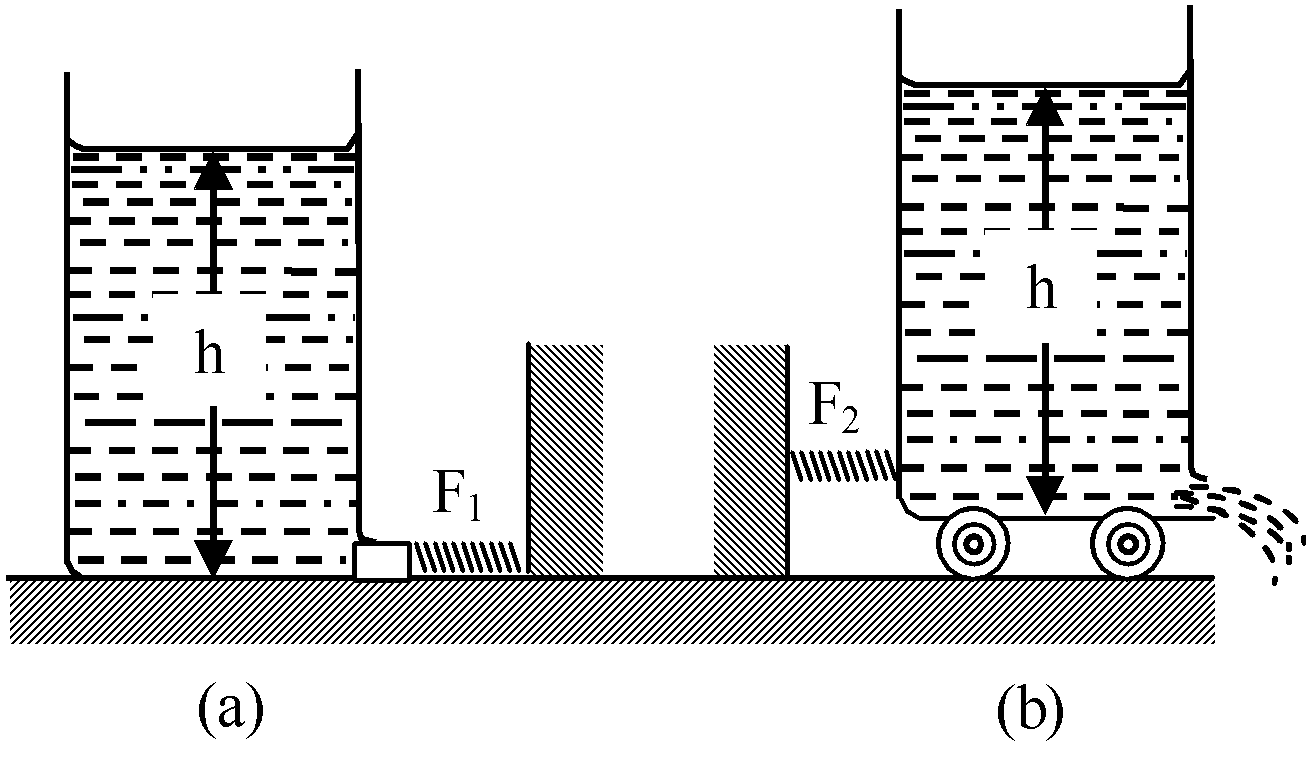
An opening S is made in a vessel containing liquid. The opening is small by comparison with the height of the column of liquid. In one case the opening is closed with a disk and the force of the liquid’s pressure F 1 on the disk is measured, when the height of the column of liquid is h (Fig.). In another case the same vessel stands on a trolley, with the opening unstopped, and the force of recoil F 2 is measured with the water flowing out at a moment when the height of the column of liquid is the same as in the first case (Fig.). Will the forces F 1 and F 2 be equal?
Text Solution
Verified by ExpertsCHECK THE SOLUTION.
Sol. Force F 1 equals the weight of a column of liquid of height h and of the same cross-section as the disk S, i.e. hS ρ g, where ρ is the density of the liquid. On the other hand force F 2 is determined by the momentum carried away by the stream of water flowing out in unit time, which equals mv = Sv ρ v = Sv 2 ρ . From Torricelli’s formula, v, the velocity of the flow of a liquid out of an opening lying at depth h, equals  Therefore
F 2 = 2hS ρ g = 2F 1 .
The fact that force F 2 is greater than F 1 can be explained by the redistribution of pressure inside the liquid while it is flowing out. When liquid flows out of a wide vessel through a small hole, the lines of flow cluster round the opening and consequently the pressure on the wall of the vessel near the opening decreases, as follows from Bernoulli’s law. Therefore the reaction to liquid flowing out is greater than the force of the static pressure on the area of the opening.
Prepare Smarter with CGP Edu
Get practice questions, solutions, and test series in one place.
Write a Review
Share your experience with this question and solution.
Commentary
Send your comment, doubt, correction, or feedback to admin.
Similar Questions
Explore conceptually related problems